
Hey! Welcome to Not Billable, your weekly dose of legal insight and trends. Stop the clock, put the timesheet down and get ready to read an about the perceptions of in-house attorneys, the crumbling crypto world, and the FTC’s concern over Instagram collecting kids’ data.
🤓 REPORTS
You Can’t Sit With Us: In-House Lawyers Are Being Blocked from the Company Lunch Table
It's the report card your legal department didn’t ask for, but might learn something from: the Association of Corporate Counsel and Everlaw have released a 2023 State of Collaboration Report. Armed with surveys from 373 in-house legal professionals in the US, this report dives deep into the intricacies of corporate legal teamwork – or lack thereof. With the bold claim of being trusted by Fortune 100 corporate counsel, 91 of the Am Law 200, and all 50 state attorneys general, this report gives in-house collaboration a grade that might need a bit of extra credit – or a guide on how to play nicely with others.
The report indicates that approximately two-thirds of legal departments are bringing more work in-house as a cost reduction strategy, which is a 59% increase from last year. Regarding satisfaction with law firms, in-house teams expressed contentment with aspects like quality and responsiveness of communication, collaboration on key strategy, understanding of company objectives, and project management.
THE REPORT: NOBODY'S ON THE SAME PAGE
However, less than half reported being satisfied with transparency of processes and cost predictability. The report also reflected a desire for increased collaboration among legal staff, recognizing the associated benefits and obstacles preventing legal teams from fully realizing their collaboration potential. In fact, internal partners were asked about their opinions of in-house legal departments, and they mentioned the following critiques:
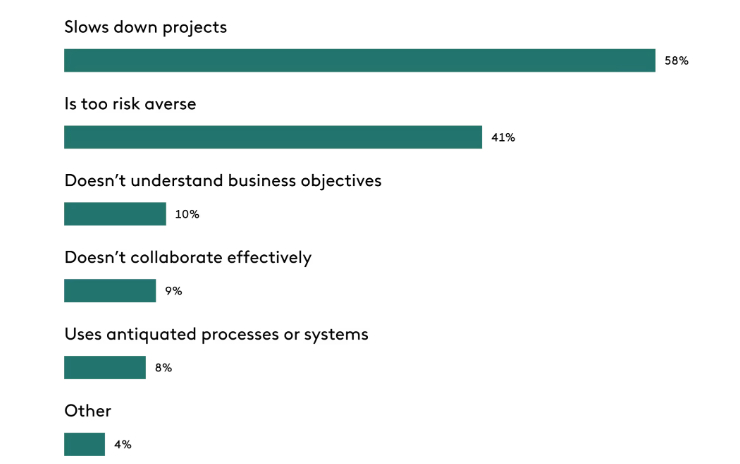
The crux of the issue: in-house lawyers are “viewed as roadblocks” by their non-legal peers, leading to their exclusion from executive tables, strategic initiatives, and important decisions. Hurtful? Sure. A step toward figuring out how to work together better? Probably.
As in-house attorneys are blocked from sitting at the cool kids table, law firms were also perceived as lacking transparency, and other partners and vendors were criticized for not understanding company objectives. However, building strong relationships has been recognized as a key to success for legal departments.
THE VERDICT:
In the Report, legal teams expressed their desire for standardized collaboration processes and integrated collaboration tools to facilitate improved external collaboration. In facts, the respondents believed that increased collaboration would result in enhanced operational efficiency (32%) and more focus on risk management and business issues (27%). It seems that in-house lawyers’ goals and reasonings aren’t always understood, and heightened efforts to communicate would make collaboration more frequent and helpful.
🪙 CRYPTO
The Crypto Market is in Retrograde
It’s Sagittarius season, but the crypto world is buzzing about Gemini Trust Co. Last week, Genesis Global — a crypto lender — sued its partner Gemini Trust Co. for almost $700 million. It seems that crypto failures are written in the stars (and in every Newsletter) recently, but the outcome for Genesis and Gemini remains up in the air.
Together, Genesis and Gemini had an investing program called Earn. Genesis re-invested Earn customers’ crypto assets, paying customers the interest. In a custodial role, Gemini is Genesis’ largest creditor and processes these deposits and withdrawals for a cut of Genesis’ payments to the customers. Unfortunately, all Genesis earned from this deal was bankruptcy: in its suit, Genesis claimed that Gemini withdrew $689 million, at the expense of other creditors, in a “run on the bank” before Genesis could file for Chapter 11 bankruptcy protection. However, Gemini argued that Genesis should repay its customers instead of focusing on clawing back all the withdrawals the customers made. Currently, Genesis is involved in a NY civil fraud lawsuit that might force it into a bankruptcy liquidation. This liquidation would return some crypto assets to customers, but would not resolve Genesis’ many legal issues.
The beef here has a bunch of tiers. There’s the issue of Gemini knowing Genesis’ loans were under-secured (and very concentrated at SBF’s crypto hedge fund Alameda, which has dug itself a hole). There’s also the allegation that Gemini, despite internal analyses revealing Genesis’ financial backing was shaky, billed the Earn program as a “low risk investment” opportunity. (And we all know the stereotype that Geminis are two-faced.) Further, the SEC sued Genesis, Gemini, and Genesis’ parent company Digital Currency Group last January, alleging that they defrauded investors out of over $1 billion. And NY Attorney General Letitia James seeks to ban all three of these crypto firms from the NY investment scene.
THE VERDICT:
Genesis urges the court to remedy this “unfairness and return Defendants to the same position as Plaintiff’s other similarly-situated creditors.” But it seems that nobody involved stands to win — with almost $700 million in limbo, it’s likely that Genesis and Gemini’s legal troubles are far from over.
📱 SOCIAL MEDIA
Cashing in on iPad Kids: FTC v. Meta
TikTok makes 98% of its income from ads personalized by using scrollers’ data. Meta, which owns Facebook, Instagram, and WhatsApp, is in hot water for children’s data comprising a chunk of this statistic. Yesterday, Meta announced its intention to appeal the ruling that US regulators may try to reduce the amount that money social media companies profit off of under-18 users — but it doesn’t look like Meta’s battle for the iPad kids will be over anytime soon.
In May, the FTC brought suit against Meta for dishonest representation about parental controls on the Messenger Kids app, routine documentation of underage (under 13) Instagram users, and collecting children’s data. Despite reaching a $5 billion settlement in 2019, the FTC wants to “tighten the 2019 settlement to bar Meta from making money off data collected on users under age 18.” From facial recognition technology to virtual reality to social media data collection, the FTC is set on establishing a different set of regulations Meta must follow for underage users.
Meta also came under fire in October when a bipartisan group of 42 attorneys sued the company for targeting underage users with addictive Facebook and Instagram features. Alleging that Meta’s algorithms, notifications, and “infinite scroll through platform feeds” are purposefully enthralling young people to use social media frequently and for long periods of time, this group argues that kids’ mental health is suffering by Meta’s hand. The federal suit also alleges that Meta is in violation of the Children’s Online Privacy Protection which bars the collection of under-13-year-olds’ personal data without parental consent.
THE VERDICT:
As Meta pledges to keep fighting, kids undoubtedly keep scrolling. In a 2022 Pew Research study investigating teenagers’ frequency of using YouTube, TikTok, Instagram, Snapchat and Facebook, 35% reported using at least one of them “almost constantly.” Meta’s platforms are popular with young users, and we’re in uncharted territory as the courts debate how to handle and protect underage users’ data.